
THE PROBLEM
When I arrived at S&T, there was no CMO. Marketing existed — a capable team, a real budget — but it reported up through another function, which meant the voice for brand and customer experience never sat at the strategy table. Decisions were made by operations, finance, and sales. Marketing was informed afterward.
The brand itself was doing the predictable thing for a company without a seat at that table. S&T was presenting one face to four very different audiences: residential consumers, business buyers, advertising clients, and the communities the company served. A family shopping for home internet and a CIO evaluating enterprise connectivity were seeing the same logo, the same voice, and very nearly the same page. The company was one brand pretending to speak to one market. In reality, it was four markets being under-served at the same time.
There was also no CMO seat to argue otherwise.
The insight
A brand trying to speak to four audiences with one voice ends up speaking to none of them. And no rebrand fixes that unless a marketing leader has the rank to make the case and hold the line.
The rebrand wasn’t the work. The seat was.
WHAT I LED
The first thing I did was ensure the title. The role had been scoped as a marketing leadership position; I accepted it as Chief Marketing Officer, reporting to the CEO with equal voice to the CFO and CIO. That structural change — the decision that preceded every other decision — was what made the rest of the work possible.
From that seat, I led:
A parent-brand refresh and a flexible visual system
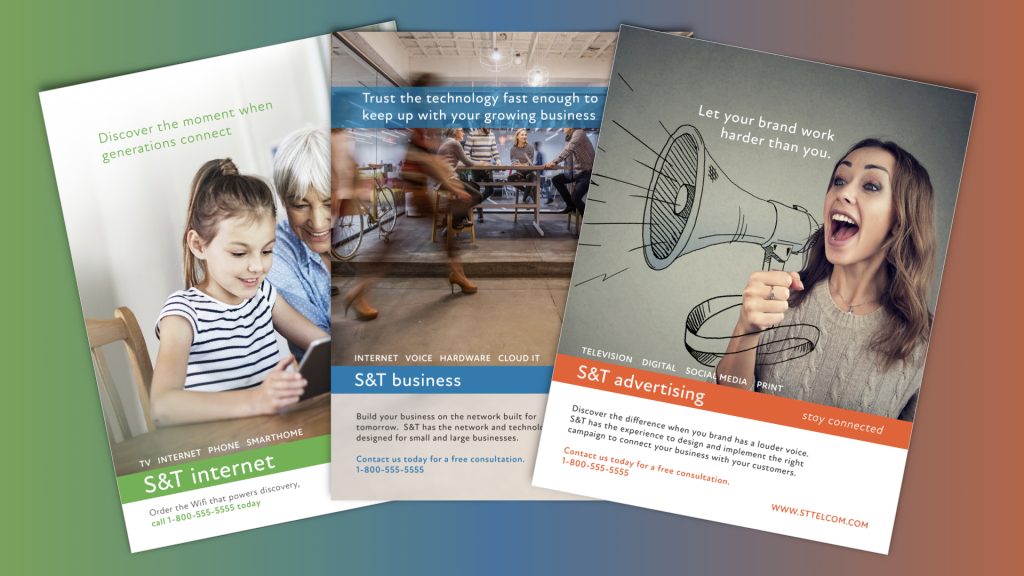
We updated the S&T master mark and built an identity system flexible enough to support four sub-brands beneath it without fragmenting the parent. The system was designed to travel across channels that had almost nothing in common — a broadcast spot for residential customers, a technical case study for enterprise buyers, a sales one-pager for media buyers, and a community-event banner — without ever reading as four unrelated companies.
Four sub-brands, each with its own value proposition
- S&T Home — residential connectivity and communications, spoken to as a B2C audience with domestic, family-facing messaging and channels.
- S&T Business — small-business and enterprise technology services, spoken to as a B2B audience through trade events, sales enablement, and technical content.
- S&T Advertising — media and advertising inventory, a separate B2B audience with entirely different buyers, reached through direct outreach to media planners.
- S&T Community — the service-and-presence side of the company, spoken to as a regional citizen rather than a commercial audience.
Each sub-brand got its own positioning line, creative tone, media mix, and success metric. The four were legibly related — same parent, same visual DNA — and independently sharp in their own markets.

A sales team realigned around the sub-brand map
Residential reps stopped chasing enterprise leads, and commercial reps stopped filling residential pipelines. Territories and quota structures were rebuilt around the sub-brand map. The team stopped competing with itself for attention on the same accounts and started specializing in audiences they could actually serve well.
A new role: Brand Evangelist
For the S&T Community sub-brand, a traditional campaign wasn’t the right shape. The work had to be done in person, in the community, by people who could represent the company credibly across the region. I created the Brand Evangelist role and staffed it by redirecting salespeople who were naturally creative, outward-facing, and identified more with the mission than the quota. They weren’t new hires. They were the right people who had been in the wrong roles — moved into roles that actually matched what they were good at.
The Brand Evangelist team became the face of S&T Community in the service area. They weren’t carrying a deck; they were carrying the brand.
THE WORK
The visible deliverables were the ones a board meeting would notice: the refreshed visual identity, the four sub-brand systems, the new website architecture, and the refreshed sales and marketing collateral. The less visible work — the work that actually changed the company — was structural. A new org chart with the CMO seat in it. Quarterly marketing presentations at the executive table. A Brand Evangelist team with a charter that didn’t exist anywhere else in the industry. Those artifacts outlasted the campaigns.
THE OUTCOME
Three outcomes mattered most.
- Decision-making accelerated. With the CMO seat at the executive table, brand and customer considerations entered strategic decisions at the same moment as cost and operations — not as a second-round review. Decisions that used to take three meetings took one.
- Segment clarity followed the architecture. Each sub-brand had a clear target, channel mix, and value proposition. Internally, teams stopped arguing about who the customer was, because the sub-brand answered the question before the meeting started.
- The community brand became an asset. With the Brand Evangelist team in market, S&T Community stopped being an afterthought and became the part of the company the region recognized most personally. That recognition compounded over time in ways a campaign could not have produced.
What I’d do differently
I under-invested in the internal rollout. I assumed that because the four-brand architecture was logically clarifying, the internal audience would experience it as clarifying. For the first few months, they didn’t. They experienced it as “more things to learn” before they understood it as “fewer things to be confused about.” If I ran it again, I would spend the first ninety days teaching the internal audience the new architecture before turning any of it outward. Clarity without education reads as complexity.
The structural lesson
The S&T work is the clearest example I have of an argument I make often: no CMO seat, no meaningful rebrand. If the marketing leader has a Director’s title and a peer group of VPs, the rebrand is decoration. If the marketing leader has an equal voice, the rebrand is the start of a structural change the company can actually compound on.
Right seat. Right sub-brands. Right people in the right roles.
The logo was the smallest thing we changed.
Related